I was teaching a Business Productivity class with Dascha a few weeks back. We'd added a new exercise, because enough learners, (Copilot users especially), had told us the same thing. The answers just weren't very good.
The exercise: build a context prompt before you ask AI for anything real. A context prompt is one document, plain text is fine, that tells the AI who you are, how you like to work, and what you care about, so you're not starting from zero every single chat.
Someone in the room asked what's actually in mine. I hadn't planned to answer this on the spot, but here's roughly what I said.
The Problem
Most people prompt AI the same way every time. New chat, new stranger. You explain your job, your tone, what you're trying to do, again. Then you close the tab and do it all again tomorrow.
That's not an AI problem. That's a YOU problem. You haven't told it who you are yet, not properly, and you're expected to keep retelling it.

What's in Mine?
Three things, kept in one file, pasted in or uploaded wherever I'm working.
My strengths report.
My HIGH5 top five are Catalyst, Commander, Storyteller, Philomath, Deliverer, mostly sitting in the Motivating domain. That tells AI what it needs to know about working with me before I've said a word: I want momentum, not a meeting. I'll make a call fast. I'll say what I think directly. I'll lose interest if you make me wait for the point. Whatever strengths tool you've done, HIGH5, Clifton, doesn't matter, put it in. It's not a personality quiz result sitting in a drawer, it's a working manual for how you want to be worked with (I have my 'special needs'!).
Our tone of voice guide.
The whole document, not a summary. Kiwi, upbeat, funny, no jargon, gets things done. We wrote it once. No reason to make AI guess at it every time. We have one of these for AI Supercharge, and every company needs one (if they don't have it already)
"Made to Stick".
Chip and Dan Heath's book on why some ideas land and others get forgotten. Six principles, SUCCESs: simple, unexpected, concrete, credible, emotional, story-driven. For whatever reason, this has always been my favourite marketing book; I guess it articulates what I have always believed about human communications anyway. I got AI to summarise it once, my own version, and now I drop that summary in whenever I want an idea, a post, a piece of training content checked against it, rather than re-explaining the framework from scratch.
That's it. Three things. Ten minutes to put together, reused every single day since.

The Result
Ask for a blog idea, a training email, with that context sitting there, and you get something already shaped like you. Not something generic you then have to rewrite by hand.
After class, I went looking for whether anyone had done this properly, because mine's honestly a bit scrappy. Found a piece by Ruben Hassid that does it right. His point: your "voice" isn't as mysterious as you think. It's mostly what you refuse to do, not what you do. "Write in a friendly tone" tells AI nothing. "Never start with 'in today's fast-paced world', never use the word leverage, keep paragraphs under three sentences" tells it everything.
He built his context by having Claude interview him, one question at a time, a hundred questions across seven categories: beliefs, writing mechanics, things that make him cringe, how he handles humour and disagreement, how he structures ideas, hard nos, red flags. All of it saved into one file, uploaded wherever he needs his own voice back.
That's the proper, more considered version. Mine's the beginner's version. Both work. You just get sharper results the more specific you're willing to be about yourself.
Where To Keep It
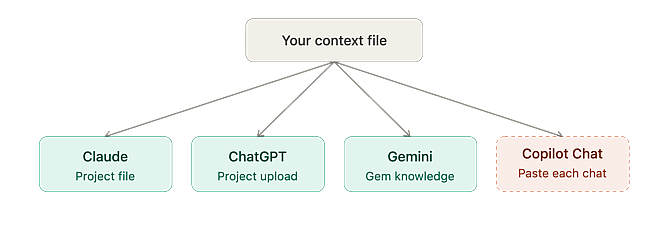
Claude: Save it as a file inside a Project, or in Claude Cowork's folder. It's there every time you open a new chat in that project, nothing to paste.
ChatGPT: Same idea, upload it into a Project. At minimum, put the essentials into Custom Instructions so it applies everywhere.
Gemini: This is what a Gem is for. Upload your context file as part of the Gem's knowledge and it's permanent.
Copilot: The honest bit. Copilot Chat, (what most of you are using in our government classes), does not carry context between chats. Every new window is a stranger. Until that changes, keep the doc saved somewhere easy and paste it in as your first message, every new chat. Ten seconds of pasting beats ten minutes of re-explaining yourself.
Try It
Don't overthink your first one (five minutes, no more!). Strengths report, style guide, favourite framework, whatever you've got lying around. Get specific about what you'd never say or do, not just what you like. That's where the actual signal is.
Want to build this properly, not just bodge one together on a Tuesday afternoon? That's exactly the kind of practical AI skill we cover in our October course. Let's get supercharged together!
